The Ritual of the Jersey: What Soccer Teaches About Belonging
When Argentina faces Bolivia or Japan meets Ecuador, millions participate in something ancient: communal meaning-making through shared ritual, unmediated by algorithms.
The Ritual of the Jersey: What Soccer Teaches About Belonging
Twice this week, millions of people will stop what they're doing, gather in living rooms or public squares, and participate in a 90-minute ritual that predates the internet by more than a century. Argentina plays Bolivia. Japan faces Ecuador. The scores matter and don't matter. What matters more is the gathering itself.
We've built platforms that promise connection but deliver isolation wrapped in the language of community. We scroll feeds curated by invisible systems, double-tap images from people we've never met, and call it social life. Meanwhile, something older persists: the human need to belong to something larger than ourselves, to share meaning with others in real time, in the same space, breathing the same air.
Soccer—football to most of the world—offers a masterclass in technology serving human connection rather than replacing it. Yes, we watch on screens. Yes, we check scores on our phones. But the technology remains stubbornly subordinate to the thing itself: people gathering around a shared story, their attention synchronized not by an algorithm but by a ball and a clock.
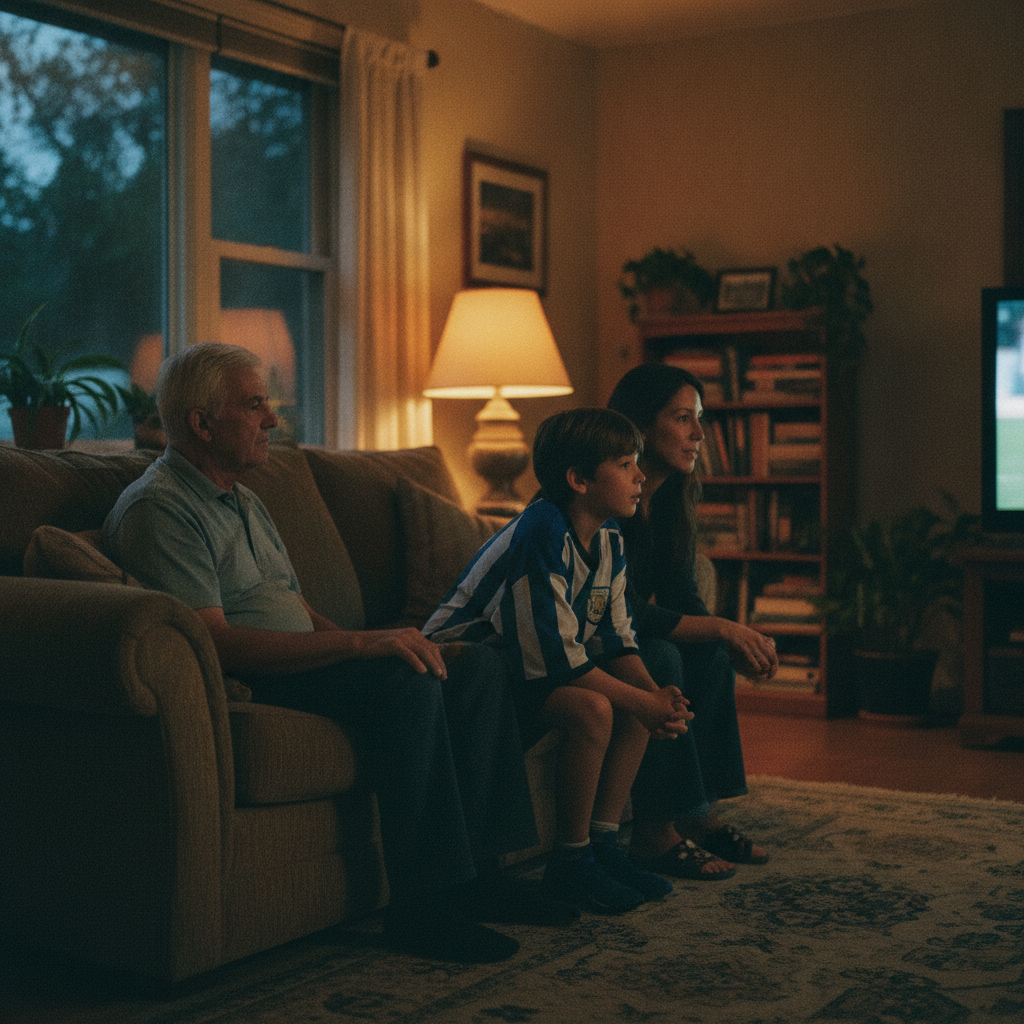
Consider what happens in a household when a national team plays. The television becomes a hearth. Multiple generations occupy the same room, a rarity in an age of personalized devices and fragmented attention. The teenager who usually inhabits noise-canceling headphones sits next to the grandfather. They watch the same thing, at the same time, with no ability to skip ahead or rewind or customize the experience to their preferences.
This enforced synchronicity—everyone seeing the same moment unfold simultaneously—creates something algorithms cannot: genuine shared experience. When the goal goes in, the eruption is collective. The despair of a near-miss ripples through the room in real time. No one is watching their personalized highlight reel. No one is seeing a feed optimized for their engagement profile. Everyone is simply present to what is happening, together.
The relational domain of our humanity hungers for exactly this: presence, synchronicity, shared attention toward a common focal point. We are not designed to live in parallel realities, each of us consuming content tailored to maximize our individual engagement metrics. We are designed for communion—literal togetherness, the strange alchemy that happens when multiple consciousnesses attend to the same reality simultaneously.
Soccer preserves another endangered practice: ritualized time. The match starts when it starts. It ends when it ends. You cannot pause it and come back later. You cannot watch it at 1.5x speed. The 90 minutes impose themselves on you, demanding that you bend your schedule to the game's schedule rather than the reverse. This is the opposite of on-demand consumption. It is appointment viewing in its most primal form.
In a culture where we've trained ourselves to refuse any constraint on our autonomy, where every service promises to deliver exactly what we want exactly when we want it, soccer says: No. The game happens at 3 p.m. on Saturday. You will arrange your life around it, or you will miss it. And millions of people gladly submit to this constraint because they understand something important: shared constraints create shared experience, and shared experience creates belonging.
The jerseys matter too. When someone pulls on an Argentina jersey or a Japan jersey, they are performing an ancient human act: declaring membership in a tribe, signaling allegiance to something beyond the self. The jersey says, "I belong to this group. These are my people." It is identity formation through voluntary association, which is perhaps the healthiest kind.
Notice that this identity formation happens without surveillance. FIFA is not tracking your emotional responses to determine which team you should support next. The jersey manufacturer is not A/B testing different shades of blue to optimize your purchasing behavior. You choose your team for reasons that remain blessedly opaque to data collection: family history, geography, a player you admired as a child, pure aesthetic preference. Your allegiance is yours.
The relational power of soccer extends beyond the household to the public square. Watch fans gather in plazas to view matches on large screens. Watch entire neighborhoods erupt in celebration or groan in unison. These are not curated experiences. No one has optimized the crowd for engagement. People simply show up, stand together, and participate in something larger than themselves.
This is what technology should do: facilitate genuine human gathering without becoming the center of attention. The screen shows the game. The game gathers the people. The people create the meaning. The technology enables but does not dominate. It serves but does not rule.
We need more of this. We need more reasons to be in the same room with other humans, attending to the same thing, unable to customize or optimize or personalize the experience. We need more enforced synchronicity, more ritualized time, more practices that demand we show up when they happen rather than consuming them on our own schedule.
The match between Argentina and Bolivia will not change the world. Japan versus Ecuador will not solve our loneliness epidemic. But both games will create thousands of small moments of genuine human connection—people gathered, attention shared, belonging enacted through the simple act of watching together.
In a fragmented age, this is no small thing. The jersey, the gathering, the synchronized attention, the shared eruption of joy or disappointment—these are technologies far older and far more powerful than any algorithm. They are the technologies of communion. They still work. We should use them more.